What went wrong, and what happens next
The studies are sound. The step that selected which five to study was not, and I did not notice until I went looking.
Claim tested
That the process, having produced five detailed studies, was working.
Result
Four errors found, one of them consequential enough to change the next batch of work.
Consequence
The next four pieces of work are tests of specific weaknesses rather than more of the same.
The error log
Four mistakes, in the order I found them. The "found by" line is the part that matters.
The gate produced 49 names before it produced 57. The earlier version applied the Altman Z-score to financial companies, where Z is not defined and generates artefacts. One bank scored 192.8, which is not an outlier so much as a signal that the formula had been fed inputs it was never designed for. Eight companies were eliminated on a meaningless number. Financials now take a gearing-based test instead.
Cross-checking which companies had survived, I used a column called screen_pass_v1, on the reasonable assumption that a field with that name records whether a company passed the screen. It does not — it is an earlier data-availability triage flag with values of pass, hold and exclude, recorded before the fundamentals data was ever attached. Any analysis built on it would have been describing a different filter entirely. The gates were rebuilt from the raw fields and reproduce the published funnel exactly.
The rule was: select companies that are cheap on at least two independent dimensions and have an identifiable structural reason for being available. Smiths News is a FTSE SmallCap constituent with roughly ten times the daily volume of the AIM names in the queue — mechanically the least institutionally-inaccessible of the five, which sits awkwardly against a project founded on structural inaccessibility. FW Thorpe was selected without meeting the two-dimensions rule at all, presumably as a quality contrast case. Both defensible, both unrecorded at the time.
This is the one worth sitting with. Checking whether the earnings-positive gate was excluding genuine value, I found it mostly is not: the bucket closest to "cheap but not broken" is 83% earnings-positive before any gate touches it. The one genuine casualty is turnaround situations, at 67% loss-making. But the same check surfaced eight companies in the 57 with a strong value classification that were never looked at.
Gate correction erratum — erratum-01-2026-09-09.md
Issued 9 September 2026
Applies to: UK small-cap screening pipeline, gate definition v1, and the selection of five companies for detailed study
Four corrections, identified between late August and early September 2026 during a review of the pipeline's own outputs. Three are errors in the process. One is the withdrawal of an artefact that cannot be reproduced.
The company narratives and multi-year models are not affected. The corrections concern which companies entered the reading queue and which were selected from it, not the analysis of those subsequently studied.
1. Solvency metric applied outside its defined frame
Published: a first-pass gate output of 49 names.
Error: the solvency gate applied the Altman Z-score uniformly, including to the 67 financial companies in the screening universe. Z is not defined for financial institutions and produces artefacts when applied to them. One bank returned a Z-score of 192.8, which is not an extreme value so much as evidence that the formula had been given inputs it was not built for.
Effect: eight companies were excluded on a figure that carried no meaning for them.
Correction: the gate now branches by frame. Operating companies are tested on Altman Z between 1.8 and 50. Financial companies are tested on net gearing at or below 150%. The corrected output is 57 names, comprising 38 AIM and 19 FTSE SmallCap, and 41 operating companies and 16 financials.
Standing rule adopted: a metric may gate a company only where that metric is defined for the company's frame. Altman Z and EV/EBITDA are suppressed for financials throughout the pipeline.
Identified by: noticing that a Z-score of 192.8 was not a plausible value of anything.
2. Incorrect column used as the gate output
Published: cross-checks and commentary referring to a field named screen_pass_v1 as the record of which companies passed the screen.
Error: screen_pass_v1 is not the gate output. It is an earlier data-availability triage flag, populated across the full 785-name universe before any fundamentals data was attached, with three values: pass (275), hold (196) and exclude (314). Any analysis resting on it describes a different filter entirely.
Effect: confined to cross-checking commentary. No published gate output was derived from the field.
Correction: the gates were rebuilt from the underlying data fields and re-run against screener_candidates_410.csv. They reproduce the published funnel exactly: 410 → 293 → 155 → 92 → 77 → 57, with the same AIM and FTSE SmallCap split. The field has been renamed in the distributed data to screener_triage_785.csv to prevent recurrence.
Identified by: a cross-check returning a number that was too convenient.
3. Selection of the five companies departed from the stated rule
Published: five companies selected for detailed study, presented as the output of the screening process.
Error: the stated selection rule requires a company to be cheap on at least two independent dimensions and to have an identifiable structural reason for being available, and prohibits selecting from the top of a single ranking. Two of the five departed from it without the departure being recorded at the time.
Smiths News is a FTSE SmallCap index constituent trading at roughly ten times the daily volume of the AIM names in the queue, making it the least institutionally inaccessible of the five. FW Thorpe did not meet the two-dimension test at all, and appears to have been selected as a quality contrast case. Both selections are defensible. Neither was documented.
The operative criterion was in fact variety across sectors, which was never written down and is not a criterion in the specification.
Effect: eight companies in the same 57-name queue carrying stronger value classifications were never examined: Card Factory, accesso Technology, Impax Asset Management, Wickes Group, Record, BTG Consulting, Gateley (Holdings) and Premier Miton Group. Three of them combine strong value and strong quality scores simultaneously, a combination none of the five studied companies has. The information needed to select better was already present in the dataset.
Correction: no retrospective change. The five studies stand as completed work. Three of the eight, being accesso Technology, Impax Asset Management and Record, are the designated next batch, specifically to test whether selection on value and quality together produces materially different outcomes than selection for sector variety did.
Standing rule adopted: selection logic is recorded as it is applied, not reconstructed afterwards.
Identified by: auditing the five against the stated rule after the studies were complete.
4. Withdrawal of an intermediate artefact
Published: a 149-row reading list, positioned between the 410-name screening universe and the 57-name queue.
Issue: the file is a genuine subset, and both the 57 gate survivors and all five studied companies sit inside it. But the rule that produced it cannot be reconstructed from the surviving artefacts. It is not a market capitalisation cut, since 404 of the 410 already fall below the threshold. Its members carry higher Piotroski scores and quality ranks than those outside it, so a filter was applied, but the filter is not recorded anywhere.
Correction: the 149-row list is withdrawn and treated as a superseded working file. The pipeline is stated as 785 → 410 → 57 → 5. That chain reproduces exactly from the published data and does not depend on the withdrawn stage.
Standing rule adopted: an intermediate output is published only where the rule that produced it is recorded alongside it.
Unaffected
The market and data source registry, the tradability and volume gate, the Companies House resolution, the hold-and-promote recovery of 135 names, and the five company narratives and multi-year models are unaffected by these corrections.
The eight
| Ticker | Company | Value rank | Quality rank | Market cap |
|---|---|---|---|---|
| CARD | Card Factory | 97 | 89 | £253m |
| ACSO | accesso Technology | 90 | 94 | £98m |
| IPX | Impax Asset Management | 89 | 94 | £137m |
| WIX | Wickes Group | 85 | 69 | £452m |
| REC | Record | 73 | 99 | £85m |
| BTG | BTG Consulting | 65 | 75 | £173m |
| GTLY | Gateley (Holdings) | 56 | 78 | £75m |
| PMI | Premier Miton Group | 56 | 95 | £60m |
Three of them combine strong value and strong quality simultaneously, a combination none of my five has. Four of my five are classified as neutral, meaning the vendor's own algorithm finds nothing distinctive about them in either direction. The five were picked for variety across sectors — that was never written down as a criterion and it is not one. The information needed to pick better was already in the spreadsheet I had paid for.
Where the process actually stands
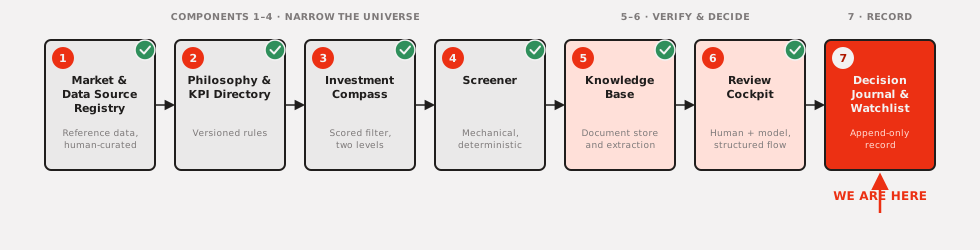
The pipeline has been run end to end once, on five of the fifty-seven names in the queue. Every stage through the multi-year rebuild has been exercised. The decision stages have not. Specifically, none of the five has been through the forced classification into unlooked-at, misunderstood or cheap-for-reason, the independent facts-only second read, or the structured human inversion producing pre-committed kill criteria. No journal entry exists.
The specification is explicit that the real success criterion is not the valuation model. It is whether the process produces a written thesis with falsifiable exit conditions that would actually be acted on and held to. By that standard, I have built good raw material five times over and have not yet run the stage the design calls irreplaceable.
No position has been taken in any company discussed, and none is recommended.
The next four pieces of work, in order of what they establish
Tests whether the stage with no evidence behind it works in practice. Roughly a day. This is the one that closes the loop, and everything else is less urgent than it.
Tests whether selecting on value and quality together produces materially different outcomes than selecting for sector variety did. The closest thing this project has to a controlled comparison.
The specification claims an industry model, built once, makes the second and third company in that sector cost a fraction of the first. All five of mine sit in five different sectors, which gave zero read on whether that is true.
Cheap, and it either validates a habit I have adopted or reveals it as a comfort blanket. Either outcome is worth knowing.